The blossoming of European Still Life paintings during the 17th and 18th centuries featured various artists exploring the different ways in which ordinary, everyday objects could be depicted and manipulated in order to convey both skill and thought. These paintings, which were usually smaller in size, were being almost mass produced to be sold in the open market in Europe, mainly to families who wanted to use them as a means of displaying wealth. Subjects such as floral arrangements, rich foods, and silver dishes and utensils were common subjects of these paintings, and artists sought to find ways to represent them in striking ways.
Despite the quick production of these works, artists still faced challenges because of the natures of their subjects. Fruits, for instance, would often decay, flowers would wilt, and breads would go stale before these paintings were completed, forcing artists to have to begin to shape their own realities. Furthermore, the flowers and foliage which artists would compile in their vases would actually not even have been in bloom at the same time, emphasizing the artist's need for mastery of subject matter. Through this, we see the artist's skill on full display, and step into the reality in which they create.
Clara Peeters, A Bouquet of Flowers, 1612, oil on wood, Accession Number 2020.22
This piece by Peeters presents a vibrant and striking jumble of flowers and wispy leaves and stems, standing alone in a green glass vase against the backdrop of a wooden table and dark amber wall. Peeters skillfully adheres to the societal expectations for a still life, while also challenging it and showing her mastery of creating a believable arrangement. In fact, none of these blooms would have been present in Peeters's studio at the same time, causing her to have to possess a mastery of all their elements, and also invent and shape a bouquet in a way that is convincing.
Clara Peeters, Still Life of Fish and Cat, after 1620, oil on panel, National Museum of Women in the Arts
In this work by Peeters, we are again met with her mastery of texture and ability to push the bounds of still life and create a space which both is convincing yet is almost impossible. The presence of the fish and oysters and silver platter adheres to the traditional purposes of Dutch still lives, showing an abundance within the household, yet the presence of that cat diverts our attention, and takes a painting which otherwise would appear static, and turns it into something dynamic and filled with tension. We feel the menacing look in the cat's eye as he hounds over his dinner, and almost anticipate to see him tear into the scales at any second.
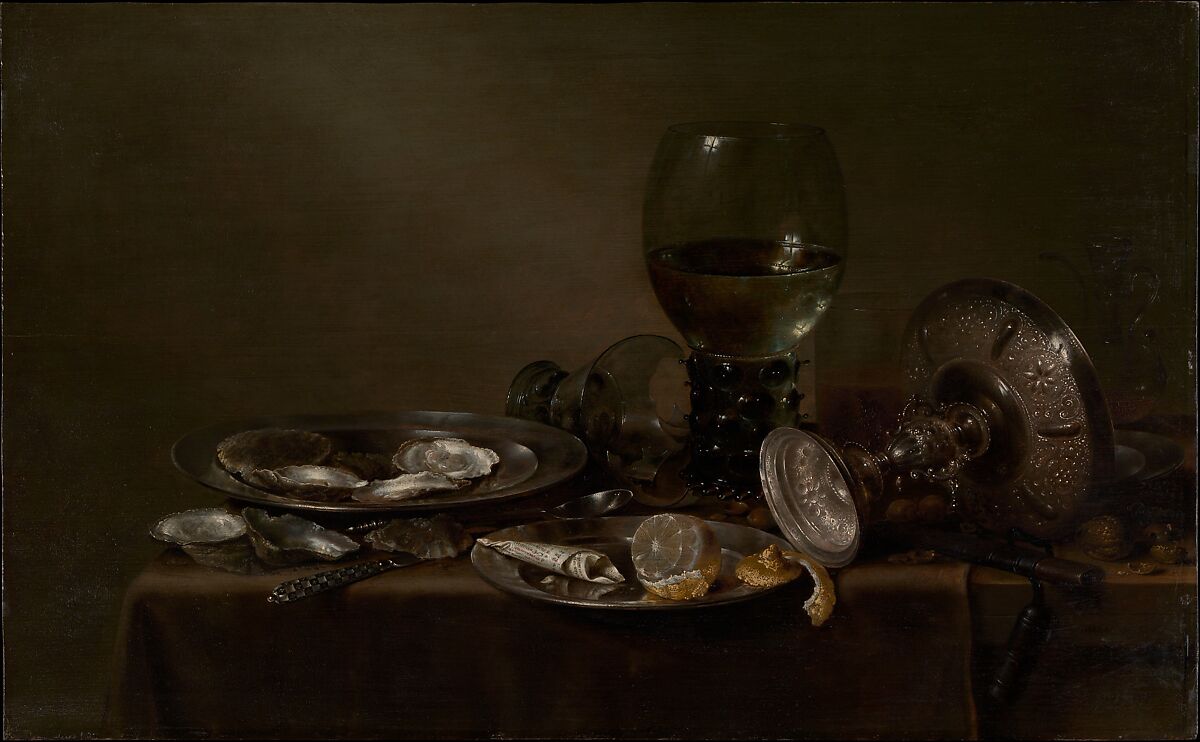
Willem Claesz Heda, Still Life with Oysters, a Silver Tazza, and Glassware, 1635, oil on wood, Accession Number 2005.331.4
Willem Claesz Heda, another Dutch still life painter, mirrors Peeters in that he fills his painting with all of the assumed elements of a provincial and abundant home, depicting large oysters, intricate silver pieces, and a glass of beer, and yet there is still something slightly askew. With closer looking, we see the presence of a broken glass, as well as a cone of paper, intended to hold spices, which has been torn and its contents scattered. Heda is renowned for his achievements in creating illusions of polished silver and shiny reflective surfaces, both characteristics of Dutch still life, yet we still see him doing something different within this painting, creating a reality of his own, pushing us to think more deeply about the luxury we see.
Orsola Maddalena Caccia, Flowers in a Grotesque Vase, 1635, oil on canvas, Accession Number 2020.263.1
This still life from the Italian painter, Orsola Maddalena Caccia, depicts yet another vase filled with blooms, which seem to all keep their individual integrity by occupying their own select space, and yet there is still unity found between the blooms as they all stem from the single vase. These flowers, like Peeters's not only wouldn't have been in bloom simultaneously, but are also occupying the space in a physically impossible way. The flowers themselves defy the laws of gravity, for if this vase were in actual space and time, the flowers would be pulled down by gravity. Yet, Caccia still manages to form a believable reality and convince us of this arrangement's existence.
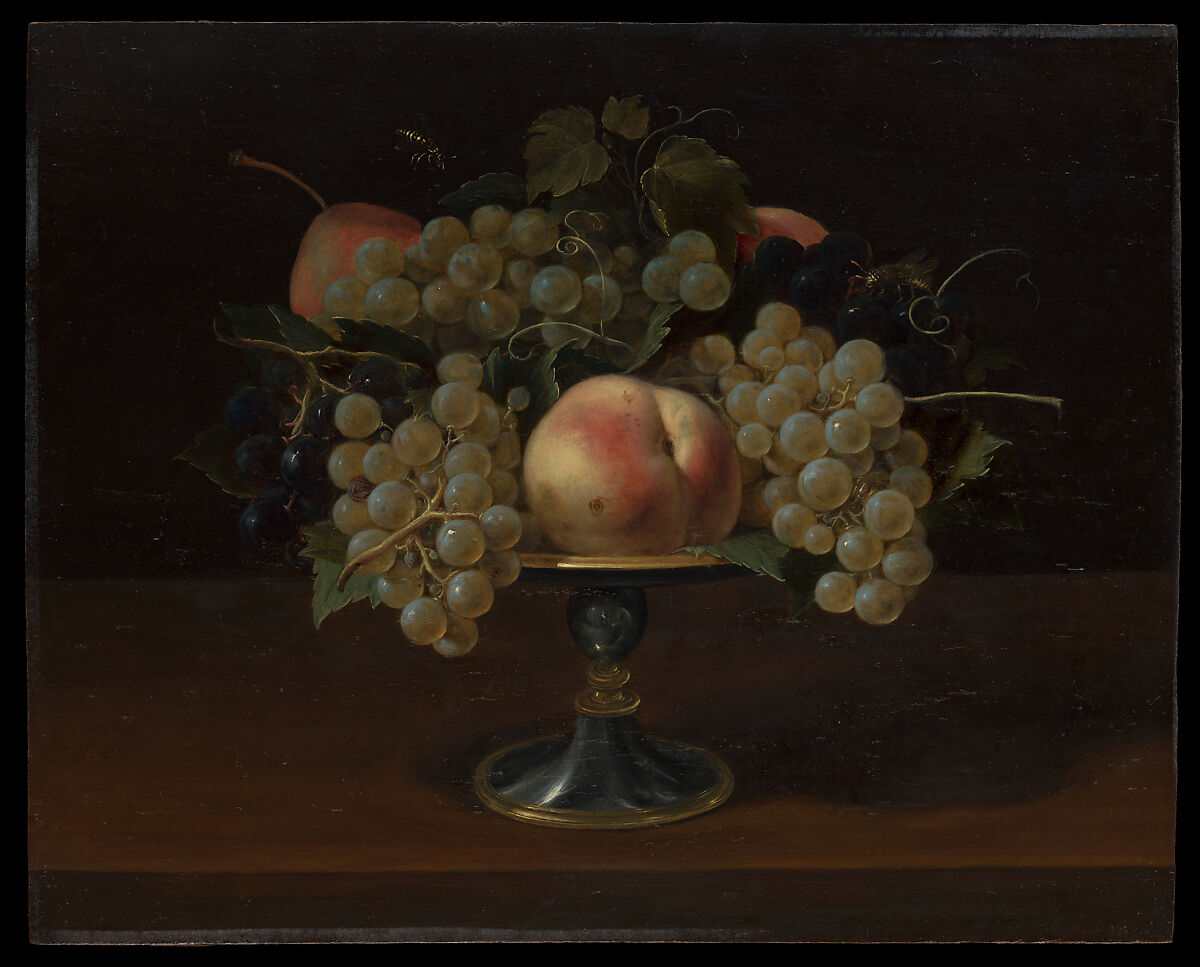
Panfilo Nuvolone, Still Life of Grapes and Peaches, 1617, oil on wood, Accession Number 2020.263.9
Within this still life by Nuvolone, we are met with peaches and grapes settled on a silver dish, and also faced with several elements which emphasize the reality that he is attempting to create and narrate. Firstly, he includes details on the fruits themselves of decay, pointing towards the truth of death and a deterioration of abundance over time. He also includes his reflection in the shiny surface of the silver, an illusion that many artists of the time used to place their subject within the context of their reality, as well as demonstrate skill and prowess.
Clara Peeters, Still Life with Flowers, a Silver-gilt Goblet, Dried Fruit, Sweetmeats, Bread sticks, Wine and a Pewter Pitcher, 1611, oil on panel, Museo Nacional Del Prado Room 082
This final work by Peeters includes several elements which demonstrate her skill in creating her own version of reality. Not only are we met by yet another vase of an impossible flower arrangement, but we are also given Peeters's reflection not one, but eight different times, all shown within the different dimensions of the bends and curves of the goblet and pitcher. She is able to create the illusion of herself masterfully, announcing to the viewer: "I am here, and this reality is mine."
Sources:
Segal, Sam, and Klara Alen. Dutch and Flemish Flower Pieces: Paintings, Drawings and Prints up to the Nineteenth Century. . Translated by Judith Deitch. Leiden: Brill / Hes & De Graaf, 2020.
Celeste Brusati, “Stilled Lives: Self-Portraiture and Self-Reflection in Seventeenth-Century Netherlandish Still-Life Painting,” Simiolus 20, no. 2/3 (1990), pp. 168–173


No comments:
Post a Comment