Saturday, December 7, 2013

The Expulsions from Paradise


         The story of the Expulsion from Paradise is widely known, yet the obvious question remains; how do you think the scene appeared? God and his angels banish the pinnacle of God’s creation; Adam and Eve are no longer allowed to remain in the Garden of Eden. The basis is the same; Adam and Eve are expelled form the Garden in each version, but the way it is depicted by every culture is different. Over the span of many centuries and across numerous different cultures there are many different versions of this story.

        The pieces chosen for this exhibit exemplify the spectrum of depictions of the Expulsion scene throughout the centuries. These pieces range from oil paintings to ink sketching’s, even the medieval period has painted this scene in their Bible in 1360. These pieces show the different views people, especially the culture of the artists on display, hold about the expulsion of the human race from Paradise, God, and the Garden of Eden itself. Even the purpose of the paintings and sketchings of the Expulsion from Paradise are exponentially dissimilar. This is why it is necessary to see the broad scope of theologies revolving around the Expulsion from Paradise.


The Impending Revolution


In the late 19th century America was experiencing a time of great change and revolution. Advancements in manufacturing were made and this brought about a change in the life style of Americans, but also in the land scape of America. For many artists at this time it became increasingly important to capture what was left of a changing land scape, that many felt was historically significant. For some artists, this meant focusing on a key aspect of the American landscape. Which at the time, had yet to be affected by the rise of manufacturing facilities. Artists such as Asher Brown Durand, Thomas Cole and Jasper Francis Cropsey wanted to capture the essence of the changing American landscape in their paintings, in hopes that people would never forget the once great American wilderness. Specifically, as seen in Thomas Cole’s The Oxbow, this meant representing not only the beauty of the landscape, but also the possibility of change and how this change would ultimately effect that landscape. Although not all landscape paintings at this time were as symbolic as Cole’s, many of them were still used to provide a window for the view into the ever changing American landscape. Today, viewers are still able to view the beauty that these artists sought to preserve through their timeless works of the Great American Landscape. 


Asher Brown Durand, The Breeches, 1845

Oil on Canvas,  15.30.59


In this oil painting by Asher Brown Durand, the essence and ease of the everyday American lifestyle is captured through his use of colors and textures. Durand is painting a scene that appears to be taking place in the late afternoon, before sundown, of a simple country farmer leading his sheep. Although it appears to be a simple scene and one of not much consequence, Durand has created a frame work for what life in America is like for the simple man. . Durands painting shows nothing of mechanical advancement being made at the time.


Asher Brown Durand, Landscape—Scene from "Thanatopsis", 1850

Oil on Canvas, 11.156


Here, we again see Asher Brown Durand's use of soft hues to communicate an essence of a simpler time. Although this scene is not as personal as The Breeches, Durand once again create a scene that has yet to show any signs that it is effected by mechanical advancements. This mountainous landscape appears almost ageless and unchanging, a fortress of strength against anything that could affect it. Similar to Thomas Cole's The Oxbow, this scene encapsulates a gentleness juxtaposed with an unknown strength.   


Asher Brown Durand, High Point: Shandaken Mountains, 1853

Oil on Canvas, 77.3.1


This last piece by Asher Brown Durand is once again setting the stage for what is to come. Durand focuses on some of the simpler aspects of American culture at the time and place. His paintings often depict farmers, and other symbols of what life was like for someone living in the American wilderness. This painting however is different from The Breeches, and Landscape—Scene from "Thanatopsis" in the way that Durand has treated the colors and how it is no longer as soft and as fair as the first two. 

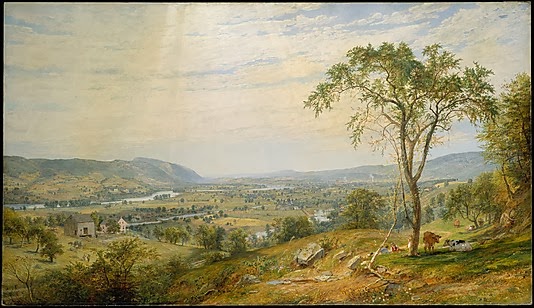
Jasper Francis Cropsey, The Valley of Wyoming, 1865

Oil on Canvas, 66.113


 The Valley of Wyoming  by Jasper Francis Cropsey, is another painting that depicts the American landscape in a time of change. Different from the work of Asher Brown Durand, Cropsey includes evidence of change in his painting. The scene shows farm land, houses and even what appears to be smoke rising out of the distance. Here we see some of the first signs of change and revolution in the American landscape as people begin to move into the country side and populate a once untouched wilderness. 


Thomas Cole, The Oxbow, 1836

Oil on Canvas, 08.228


Although The Oxbow was painted a few years a head of many of the other works, it is perhaps the work with the most disguised symbolism. The powerful juxtaposition of storm clouds and as untamed wilderness against a simple countryside have helped communicate the sense of impending danger. It is well known that Cole was a lover of the American wilderness and the outdoors, and because of this many Art Historians have interpreted this painting as being a warning of the danger that the mechanical revolution will bring to the Great American Wilderness. 


Stephen Hannock, The Oxbow: After Church, After Cole, Flooded, 2000
Acrylic, alkyd and oil glazes with collage elements on canvas, 2001.153 


Lastly, this painting by Stephen Hannock which was painted in 2000 is an amazing example of exactly how Cole's painting has changed. Through Hannock's painting we can see just how the landscape was industrialized through farming and the addition of two bridges. Not only this but we can also see how the nature within the landscape has changed; the river has flooded and once great wildness appears to have been tamed.  Hannock's painting helps to show the full circle of how industrialization changed the Great American Landscape.  


Cypresses: Techniques Influenced by Vincent van Gogh

Vincent van Gogh is notorious for his dynamic and energetic brushstrokes. He paints with various sizes and thicknesses of strokes in order to better render his forms. He uses line to create short gestured strokes and repeats this technique all throughout his pieces. Van Gogh’s style underwent most of this transformation during his stay in Paris where he saw first-hand the work of Impressionists. Following this visit, he began to experiment with his brushstrokes and handling of paint.

The focal point of my exhibit “Wheat Field with Cypresses” illustrates Van Gogh’s thick, impastoed technique created by layering paint. The different sizes of his brushstrokes function to add variety to the painting, yet this piece is unified with the overall movement created in the fields, mountains, sky, and cypresses. Van Gogh’s painting has a calming effect among his frenetic movement because he curves the strokes in a way that mimics the objects’ forms. This exhibit is going to specifically focus on the cypresses from this composition so that the brushwork and technique of creating this specific area can be further studied and compared to other works. The surrounding pieces exhibit how Van Gogh’s brushwork and linear qualities have influenced other illustrations of cypresses, been improvised in his own, and how a completely new mood can be created when the cypresses are rendered in a different fashion. The exhibit is arranged in a way so that the viewer is able to compare the technique of Van Gogh’s sketches and paintings of cypresses side-by-side to other artists.


Vincent van Gogh, Wheat Field with Cypresses, 1889
oil on canvas, The Metropolitan Museum of Art, 1993.132

The cypresses in this painting are constructed with brushstrokes predominately moving vertically on the page. These strokes off-balance the overall horizontal composition, yet mimic the lines in the wheat fields. These strokes are layered on the canvas in the same manner the leaves would be layering one another on the actual cypress. This method provides texture and trust that this is truly what a cypress looks like, while the methods of illustrating are obviously stylized.


Vincent van Gogh, Wheat Field, 1888
Reed pen and iron gall ink over graphite on wove paper, The Metropolitan Museum of Art, 64.125.3

This breakdown of the construction of the wheat field in ink displays the very fundamental aspect of mark making. Without color, Van Gogh constructs this piece purely with the repetition of various lines. It is almost as if he is mapping out what could be future brushstrokes in a large-scaled landscape. The cypresses are simplified in this piece to few lines, yet their mass is present with the repetition and layering of the lines in this drawing.


Louis Valtat, Italian Landscape, Cypresses, 1902
oil on panel, Private Collection

Louis Valtat creates a landscape similar to Van Gogh’s Wheat Field with Cypresses. His composition illustrates more cypresses, but a field and mountain range exists in the background like Van Gogh’s. Valtat’s landscape incorporates brushwork that is similar to Van Gogh’s and creates movement throughout the piece. However, Valtat’s strokes are thicker and more blended, yet has less texture. There is less detail in the background, where Van Gogh details his background with larger brushwork. Although the color schemes are very similar, muted cool colors, the mood in Italian Landscape is less mystical because the brushstrokes are larger and rougher.


Vincent van Gogh, Cypresses, 1889
ink, The Brooklyn Museum

This ink drawing alludes to Van Gogh’s later oil painting and appears to be the same cypress composition. When viewing this in relation to his Wheat Field with Cypresses, it is intriguing to see the immense detail and repetition applied in this drawing. These trees embody less vertical lines and more curving and spiraling movements. Van Gogh achieves value by making heavier ink marks in darker regions and creates tints with more washed out ink. His handiwork creates a more dream-like mood with his whimsical and flowing lines.


Vincent van Gogh, Cypresses, 1889
oil on canvas, The Metropolitan Museum of Art 49.30

After viewing Van Gogh’s ink drawing, the viewer is able to envision the intentionality of each stroke on the canvas. Combining oil paint with his technique of short frenetic lines, he is able to create more layering and texture on the canvas that is not easily recreated with ink. His color scheme alludes to the dream-like and calming mood created in the drawing with cooler and softer colors. This composition seems as if it were taken directly from Wheat Field with Cypresses, but rendered with more detail and finer lines.


Edward Weston, Cypress, Point Lobos, 1929
printed ca. 1954, Gelatin silver print, The Metropolitan Museum of Art, 57.519.2

This print is remarkable in its similarities with Van Gogh’s drawings and paintings, not only with the subject matter, but also with the detailed lines captured in this image from an actual cypress. The stark contrast of light and dark in this print further emphasizes the lines throughout. The mood created in this print is not the same as Van Gogh’s, primarily because there is a lack of color and such an abrupt light contrast. Due to this, the print creates a more dramatic, yet somber feel. The lines at the base of the tree are mimicked in Van Gogh’s paintings and linear techniques. Van Gogh recreates similar curved and frenetic repetitions, just as this cypress naturalistically does so. This causes the viewer to question if the bark of the tree could have been Van Gogh’s inspiration for his technique when illustrating one.


Jim Keeling, The Golden Cypress, 2011
ceramic sculpture, oil gilded with gold leaf, Hillier exhibit- Chelsea Flower Show

While this is not the focal point of this exhibit, this 3.1m sculpture would ideally be placed in the center of the room. Jim Keeling created this cypress sculpture after being inspired by Vincent van Gogh’s A Starry Night. This sculpture is a beautiful example of how Van Gogh’s techniques can be transferred to a variety of mediums. Keeling recreates the movement and texturized paint by layering pieces of his sculpture and carving in a manner that alludes to Van Gogh’s brushwork. Incorporating this three-dimensional piece into the exhibit allows for the viewer to witness how Van Gogh’s work is able to influence a sculpture and mimic Van Gogh’s repeated lines and layered brushwork.


Athleticism: A Symbol Through Time


“You were made to soar, to crash to earth, then to rise and soar again.”
Alfred Wainwright
Throughout history, athletes have been depicted in various forms, but all rooted in some form to the traditional symbol of athletes as ideal strength and power. How have artists, using various forms and styles of art, depicted different cultural definitions of athletes by alluding to or manipulating the traditional symbolic context?
In Ancient Greece, an artist depicting young and strong athletes was the norm, their bodies exaggerated to ideal perfection. The carved marble and bronze figures were the epitome of bodies in motion. The gods were Olympians – sports heroes – and artists elevated man in their sculptures and pottery to attain that perfection. In our own modern culture, reverence for athletes remains. The roots of that reverence began in Ancient Greece thousands of years ago.
Athletes have become a symbol of raw ideals of humanity: strength, perseverance, endurance, and power. This traditional symbol is deeply rooted in the psyche of human culture, reflected in such things like the Olympics. The world pulls together to compete and push the body to the limit. Countrymen are inspired by their beloved athletes, taking their victory as their own. This symbol has been reflected in art in a more modern context as well, combining the traditional ideals of mankind with the culture of today. The artist tells a new story, adds a new piece to the tradition: Athletes juxtaposed with progress or chaos. As Wainwright said, humans rise and fall, but the athlete will always be a symbol of humanity’s hope of the upward climb, of pushing ourselves past the point of exhaustion and being born into the tradition of the gods.
These pieces are ordered chronologically to see the progression through time as athletes are manipulated to serve the artist’s purposes.

Unknown, Bronze diskos thrower, ca. 480-460 B.C.
Bronze, Metropolitan Museum of Art, 07.286.87


This statue proclaims achievement and success. This athlete has a body disciplined to perfection. His nose and jaw are strong lines, with muscle tone throughout his body. He has one foot forward, one arm raised to throw the diskos, but as with the classical period, there is not much motion to this bronze sculpture. He is caught in the moment before the action, before his power is unleashed. Though strength is evident in his body and he is about to release a diskos with force and momentum, his body is calm, serene. He is the frozen etching of ideal body.

Unknown, Terracotta statuette of the Diadoumenos (youth tying a fillet around his head), ca. 1st century B.C.
Terracotta, copy of a Greek bronze statue by Polykleitos, Metropolitan Museum of Art, 32.11.2


This is a copy of a famous classical Greek artist, Polykleitos. This piece is made from terracotta, a relatively inexpensive element that was used to make miniature copies for distribution. This would have been bought for personal use, displayed in the home or workplace. Though it is a copy of a classical statue, it reflects the Hellenistic period in which it was copied. The subject is in motion: his arms are raised to tie the fillet, his hips are swiveled, and his legs reflect a shift in weight. His body still reflects Greek idealism with muscles just beneath the surface of the skin, strong facial features, and so forth. This piece also reflects the strength and power of the ideal athlete body, but in motion, and it also brings this symbol into the daily life of the people.

Unknown, Bronze Statuette of a runner, ca. 2nd-1st century B.C.
Bronze, Metropolitan Museum of Art, 1972.118.93


This piece is to bring a variant form of style to contrast with the piece above. It is within the same period – Hellenistic – but takes on a different form. This is an athlete defined in a different way. The Hellenistic period, though still retaining idealistic forms, began to depict every day folk, not just gods and noblemen. Here is an example of a runner with no particular special identity. His body is stylized, elongated and thin. He is more of an individual because his nose is not the generic strong and straight nose, but oversized and unique. He does reflect the motion of this period, though, for one leg is bent to spring, and the other is raised mid step. His arms are tightly bent to his side, seemingly bearing the weight of some sticks or logs. His mouth is in a hard line – this is an athlete that puts in effort. His strength does not come easy, but he perseveres and bears his burden by his own ability. This is an athlete that we can compare ourselves to and identify with, while still aspiring to embody his spirit.

Max Weber, Athletic Contest, 1915
Oil on canvas, Metropolitan Museum of Art, 67.112


This painting depicts athletes competing in various track and field events. Weber uses the styles of Cubism and Futurism to convey the motion and speed of these athletes. This painting embodies the flurry of motion within competition, but you can just make out the individuals within the piece with jersey numbers depicted across the canvas. Unlike the previous pieces, this painting has color. Red, green, and yellow tones bring this scene to life while dark swirls and lines add to the chaos and motion, breaking up the colors. There is no specific focal point, so the viewer’s eyes are in motion with the athletes, following them along their tracks, jumping over the hurdles with them. His brush strokes add a texture and individuality to each figure within the piece as well. Weber uses techniques and styles of his day to display the traditional theme of athlete in an entirely new way.

El Lissitzky, Runner in the City, ca. 1926
Gelatin silver print, Metropolitan Museum of Art, 1987.1100.47            


This is not simply a photograph, but a photomontage of different exposed pieces, cutting this print into thin vertical strips. He exposes a runner jumping over a hurdle on a track over the city lights of Times Square, allowing the lights of the city to create a steady glow and pulse to shine through the slightly transparent runner. The traditional athlete as a hero is reinvented into an urban context of new industry and progress. Man and metal combine to symbolize a hope in the progress of human achievement, both industrial and physical, as they both hurdle forward into the optimistic future. The scene does hold a sense of chaos, yet again, for the moment is segmented and constructed apart from each other. This is an underlying theme to the total piece, but reflective of the other artists of his time. El Lissitzky is relying upon the traditional athletic symbol that is within the cultural vocabulary of his viewer, and manipulating it to preach on the progress of the 20s. These two ideals – industry and athleticism – are married together, literally glowing and running together, in a suspenseful and optimistic scene of achievement.

Piet Zwart, Topsport, ca. 1930s
Gelatin silver print, Metropolitan Museum of Art, 1987.1100.253            


Zwart created this image by cutting out these individual figures and mounting them on a series of parallel glass planes, and then photographing it to produce this print. As El Lissitsky was a part of Association of New Architects (ASNOVA) that was designing a sports club, Zwart was a part of the Association of New Advertising Designers. The members used experimental photographic methods during the 1930s, such as a photomontage such as this. There is much movement in this with varying athletes literally flying, floating, and running, their shadows tangled as much as they are. There is a sailboat racer, a jockey vying for the title in the horse raise, the tennis player with racquet raced, or the runner towards the front depicted the moment before passing the baton. The background grows from dark to light, with formally pleasing lines from the glass planes, creating a very ordered background to a chaotic show of sports. These athletes are rising from the blackness of the background, showing the supremacy of strength, but the chaos of competition.